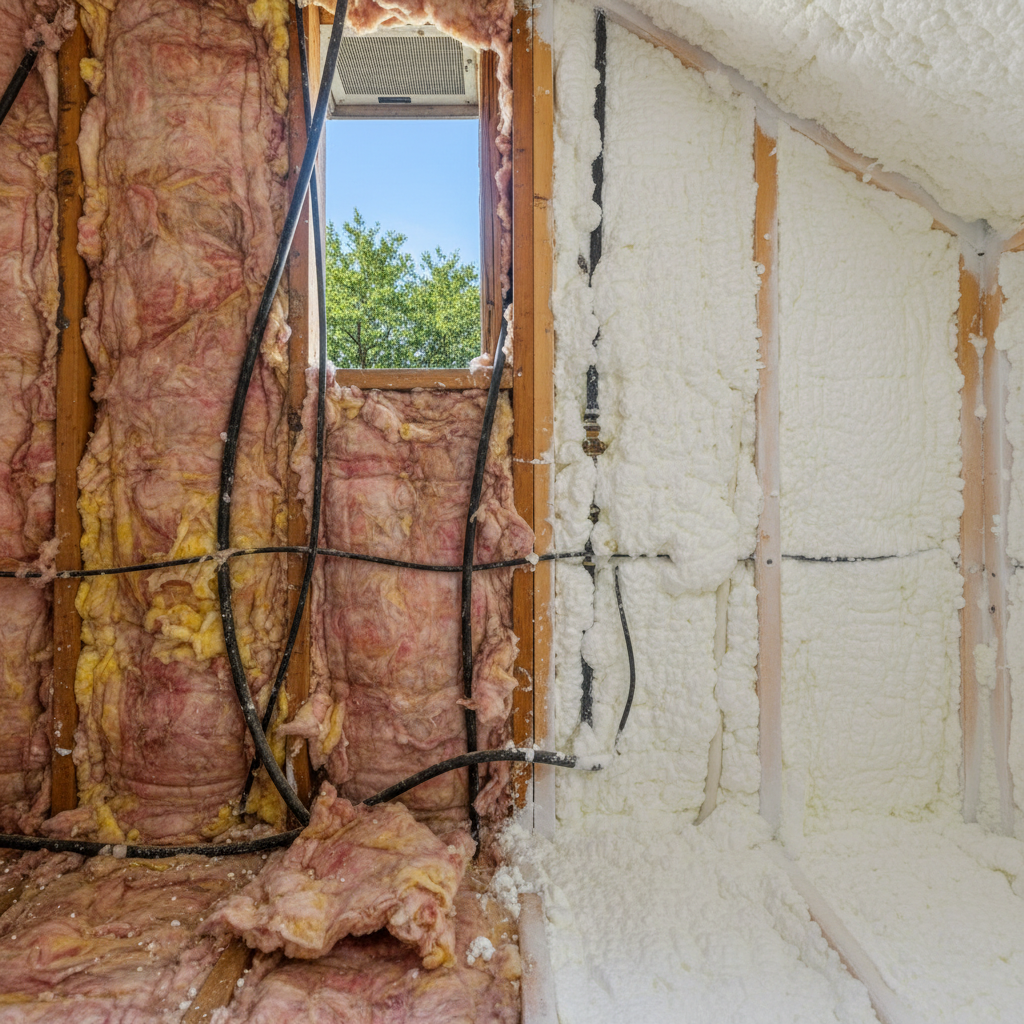
Choosing open cell spray foam for your home here in San Marcos, TX usually comes down to solving one major problem: keeping that brutal Hill Country heat out of your living space. If you are looking at your insulation options, you have probably heard contractors talk about different ways to apply open cell foam. Specifically, homeowners are often weighing a full-cavity fill against a hybrid or flash-and-batt approach.
Working on houses from the older historic properties near the square out to newer builds in TRACE, Alpha Insulation Co gets asked which method works best all the time. Let us look at how these two approaches actually compare when you factor in our local heat, shifting caliche soils, and high humidity in San Marcos, TX.
The Full-Cavity Approach
When you go with a full-cavity fill, the entire framing space—whether it is an exterior wall or the underside of your roof deck—is sprayed completely full of open cell foam. The open cell foam expands, locks into every nook and cranny, and creates a massive air barrier.
The biggest perk here is pure performance. Open cell foam is very good at stopping air movement. By filling the whole cavity, you eliminate drafts and dramatically cut down on the load your air conditioner has to carry during a 100-degree July afternoon in San Marcos, TX. Open cell foam also acts as a great sound dampener, which is handy if you live near busy spots like I-35.
On the flip side, cost is higher because you are using a lot more material. You also have to consider moisture movement. Open cell foam is vapor-permeable, meaning moisture can pass through it. In our climate, if you are spraying the roof deck to create an unvented attic, you need to make sure your moisture control and attic ventilation are dialed in properly so trapped humidity does not cause trouble for your wood decking over the years.
The Flash-and-Batt (or Hybrid) Approach
The alternative approach is the flash-and-batt method. Instead of filling the entire cavity with expensive foam, the contractor sprays a thinner layer—usually around one to two inches—of open cell foam directly against the substrate to act as an air seal. Then, the rest of the cavity is filled with a cheaper traditional insulation material, like fiberglass batts or blown-in cellulose.
Cost is the main driver for this option. You get the airtight seal of spray foam without paying for the foam to fill the entire depth of the cavity. For homeowners trying to upgrade a large attic or whole-house remodel on a tighter budget in San Marcos, TX, this can save a noticeable chunk of change upfront.
Maintenance and durability require a closer look with this method. Combining foam with fiberglass means you are relying on two very different materials to behave nicely together. If that initial foam layer is not thick enough or applied with absolute perfection, air can bypass it and hit the cooler fiberglass, leading to condensation issues when the Texas humidity shifts.
Cost, Durability, and Appearance Face-Off
When you break down the numbers, full-cavity open cell foam costs more upfront than a hybrid approach, but it pays dividends in airtightness and overall system longevity. A flash-and-batt setup saves money today, but it relies heavily on the secondary insulation staying dry and properly positioned over the years.
Durability-wise, open cell foam does not shrink or sag over time like loose materials can. However, because it is soft and sponge-like, it will not add structural rigidity to your framing the way closed-cell foam does. That is fine for most residential applications, but worth noting if you are looking for extra strength against heavy winds.
As for appearance, once the excess foam is trimmed flush with the studs, it is almost always covered up by drywall or a thermal barrier anyway. You are not looking at it day-to-day, so aesthetics inside the wall or attic cavity do not impact your daily life.
The Local Recommendation
Here in San Marcos, TX, our summers are punishing and our humidity can swing wildly from dry spells to heavy river-valley moisture. Alpha Insulation Co generally leans toward the full-cavity open cell approach when insulating unvented roof decks, provided the attic space is designed right. It gives you the ultimate air seal against the heat.
If your budget is tight, the flash-and-batt method can work well on exterior walls, provided your contractor does not skimp on the thickness of that initial foam layer. Whichever route you choose, getting the air seal right is what keeps your energy bills from eating you alive when August rolls around in San Marcos, TX.